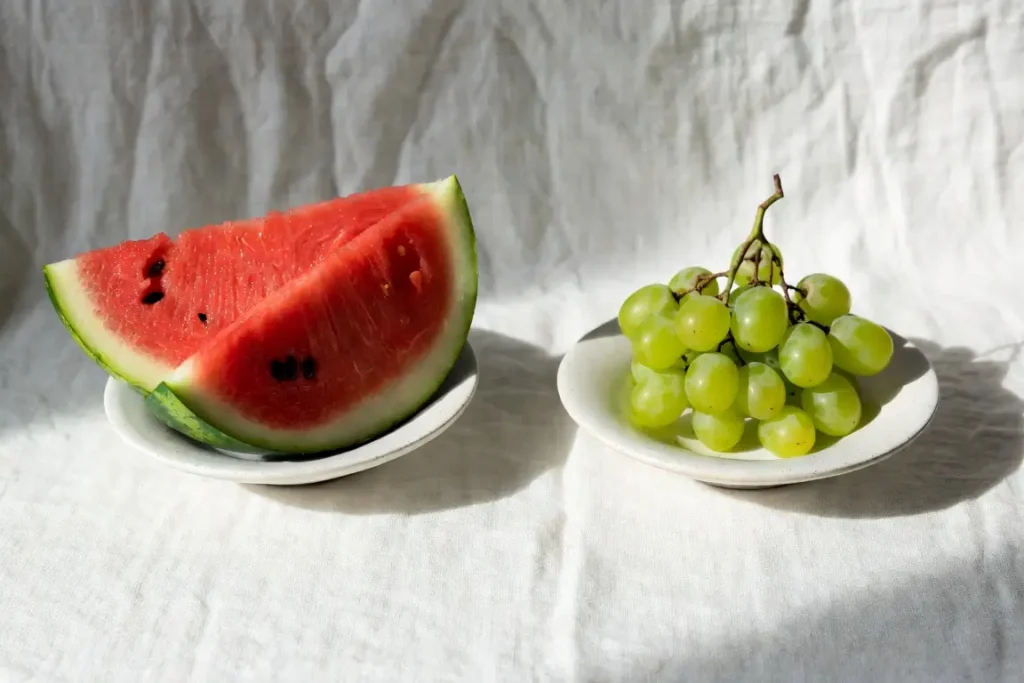
Watermelon and grapes both headline the summer fruit bowl, but they sit at opposite ends of the calorie-density spectrum.
| Nutrient | Watermelon | Grapes |
|---|---|---|
| Calories | 30 kcal | 85.9 kcal |
| Protein | 0.61 g | 0.91 g ✓ |
| Total Carbohydrate | 7.55 g | 20.2 g |
| Dietary Fiber | 0.4 g | 0.9 g ✓ |
| Total Sugars | 6.2 g ✓ | 15.5 g |
| Total Fat | 0.15 g | 0.16 g |
| Saturated Fat | 0.02 g ✓ | 0.054 g |
| Sodium | 1 mg ✓ | 7 mg |
Notable compounds in each
Watermelon
Grapes
When to choose each
Watermelon is the far lighter fruit calorie-for-calorie – under half the calories of grapes per 100g, largely down to its high water content – while grapes edge ahead on protein. Watermelon is also lower in sodium, though both are low enough that it rarely matters in practice. If you’re watching calorie density, watermelon delivers a lot more food for the same energy; if you want something more concentrated and portable, grapes win on convenience.
Common questions
Why is watermelon so much lower in calories than grapes? Mostly water content – watermelon is around 90% water by weight, which dilutes its calorie density considerably compared to grapes, a much less watery fruit.
Are grapes high in sugar? Relatively, yes for a fruit – grapes carry a more concentrated natural sugar content gram for gram than many fruits, which is part of why they’re easy to overeat compared to a lower-density fruit like watermelon.